Three Generations of Swimmers
My very first experience of an outdoor tidal pool was in St. Andrews, as a baby, at only a few weeks old.
I was taken to the now defunct, Step Rock Pool, along with my brother, aunt, cousin and grandmother, while my father went for a round of golf on The Old Course, joining us later in the day. As I grew slightly older, I have memories of summers like this, with some one venturing out, at some point, to purchase strawberry treats, from Fisher & Donaldson and days spent swimming out to the raft in the middle of the pool.
My mother grew-up swimming in, what was known as ‘The St. Leonard’s Pool’, on St. Andrews’s rugged coast, during term time and in The Step Rock Pool, during the summer holidays, when her own parents decamped from Lennie, near Glasgow, for summers spent, golfing, swimming and going to parties.
My mother says that she remembers her mother, my grandmother, who, along with her sister, my great aunt, swam for West of Scotland, racing my grandfather’s male colleagues, in swimming races, from St. Andrews Harbour, to The Step Rock Pool.
For my mother, The ‘St. Leonard’s Pool’ was a boring pool, whereas The Step Rock Pool was fun! A place where families arrived with picnics, rugs, children, grannies, aunts and cousins, set-up their spots and spent all day!
This is the magic of tidal pools, they are multi-generational third spaces, that bring multigenerational families together.
This is still very much the case. Something that I witness often, at Cellardyke Tidal Pool, where I have had one of Scottish Seaside Saunas’ outdoor saunas, since the summer of 2024, families setting-up camp, during the day, perhaps being joined by others, towards the evening and, on balmy summer evenings staying and socialising, until the sun sets.
Times of Change
When I became older, we still spent time, as a family, at The Step Rock Pool and on the beach, in St. Andrews , but spent more holiday time, as a family, in Elie.
We had a beach hut and in much the same way, to those families at tidal pools, we spent all day on the beach, interacting with other families in a very open, shared space. .
Elie Beach ‘The Beach’ remains this sociable place where people meet spontaneously and interact.
The Beach even more important a place during lockdown, when swimming and dog-walking on the beach became the main means of socialising.
In the 1980s, when my parents split-up, as a couple. My dad took us to Spain on holiday. This was a time when many of the tidal pools, across The UK, once vibrant, began to become neglected.
My mother moved to what had been our holiday home, with my two younger sisters. I remained near Glasgow, with my dad and my brother.
As an adult, I lived away from Scotland, in Whitstable, Cambridge, London, Cape Town and Sydney, always swimming, in outdoor pools, the sea, or in tidal pools, where possible. However, Elie Beach remains this open and shared space for me. To me it is the most important place in the world. A place to which I always returned and has been consistent throughout my life.
The Importance of Community
As well as Cellardyke Seaside Sauna, at Cellardyke Tidal Pool and St. Andrews Seaside Sauna, on East Sands, Scottish Seaside Saunas has 2 saunas, almost directly on the beach, at Elie Harbour. This means that Elie Beach is even more my home than ever before, as well as my place of work.
To me, my saunas exemplify this sense of shared space and discussion. This is why all of these places, the tidal pools, the beach and the saunas are so important to me: they all bring people together and promote discussion, community and understanding.
How Tidal Pools Came Back Into My Life
Having a beach and the sea, to swim in, at the bottom of my road, I did not have much reason to swim in any of The East Neuk’s tidal pools, for much of my life.
My first memory of Cellardyke Tidal Pool are from during COVID lockdown.
As someone who had grown-up, swimming in the sea, at Elie, and continued to swim outdoors, regularly, as an adult, I quickly got roped in to helping form not one, but two swim groups, 3 weeks after lockdown was announced, in April 2020.
The larger group that became known as The Elie & Earlsferry Blue Tits, grew to include almost every able-bodied woman and many men, in the village, but the smaller, almost more exclusive, group, The Rubber Duckers, was primarily for those people who wanted to swim in wetsuits and wanted to properly swim, heads under, swimming at pace and distance.
Tides were often against us. So one day, one of The Duckers suggested we visit Cellardyke Tidal Pool.
During lockdown, driving the 15mins to Cellardyke, from Elie (all in separate cars, of course) felt like and adventure. It was in so many ways. A different village and a new place to swim, was exotic, by lockdown standards.
Back then, prior to it’s renovation, to the actually getting into the pool was an adventure itself.
This was because there was no clear route into the pool.
Since it had become neglected, from some time in the 1970s, a children’s play park had been built on front of the main entrance to the pool. The ‘entrance’ was a very basic metal ladder, fixed the the wall, down to the pool.
To get to the ladder, we had to shimmy along the edge of the wall holding on to the metal fence, round the children’s play park, to the ladder, go down the ladder, then clamber over the rocks, to the pool.
Once we were in the pool, it was fabulous. Not deep, but deep enough, long and wide and empty and prefect for doing the crawl, in our wetsuits, with our heads under the water.
It was my first experience of a tidal pool, since my childhood and gave me a revocation of the magic I had enjoyed on multiple occasions generational trips to the, now, long gone, Step Rock Pool, in St. Andrews.
The Present Day
Two years after I had opened Elie Seaside Sauna’s original sauna, Cellardyke Tidal Pool Committee invited me to site a sauna next to the, freshly renovated, Cellardyke Tidal Pool.
It seems extraordinary that The Cellardyke Tidal Pool is thriving, once again, thanks to members of The Cellardyke Tidal Pool Committee and the ladies, from The Nae Richters swim group, who, together, raised £100,000 to help restore the pool. They had drained it and cleaned it and, primarily, made it more accessible .
With a vibrant community of independent traders around it, that includes a wood-fired Pizza Hut and a cute little airstream that sells coffees, Cellardyke Tidal Pool, now, draws visitors from far and wide, who come for a full day out. I guess that I was not the only person drawn by the magic of tidal pools.
Along with Pittenweem and St. Monans tidal pools, Cellardyke Tidal Pool’s story is own of civic ambition, decline, and joyful rediscovery.
To me, this mirrors almost exactly the story of cold water and heat that we build our own business around. Long before “contrast therapy” and “wellness” itself, we’re buzzwords, generations of my family and the people of this coastline were living it every summer.
How Scottish Seaside Saunas Are Working With Fife’s Tidal Pools And Established Swimming Culture
My sauna operation, Scottish Seaside Saunas, reflects this and has the word ‘seaside’ in its name, as this is the spirt of what we do, offer our guests a seaside experience, all year round.
St Andrews, sea bathing already had deep roots. The Step Rock pool had first been built in 1903. But it was the interwar years that turned Step Rock into the true heart of the town’s social life: from 1929 women were finally permitted to use the pool, and a full complex grew up around it, including a kiosk, a small sandy beach, and proper changing facilities.
Further round the coast, the East Neuk villages built their own versions of the same idea.
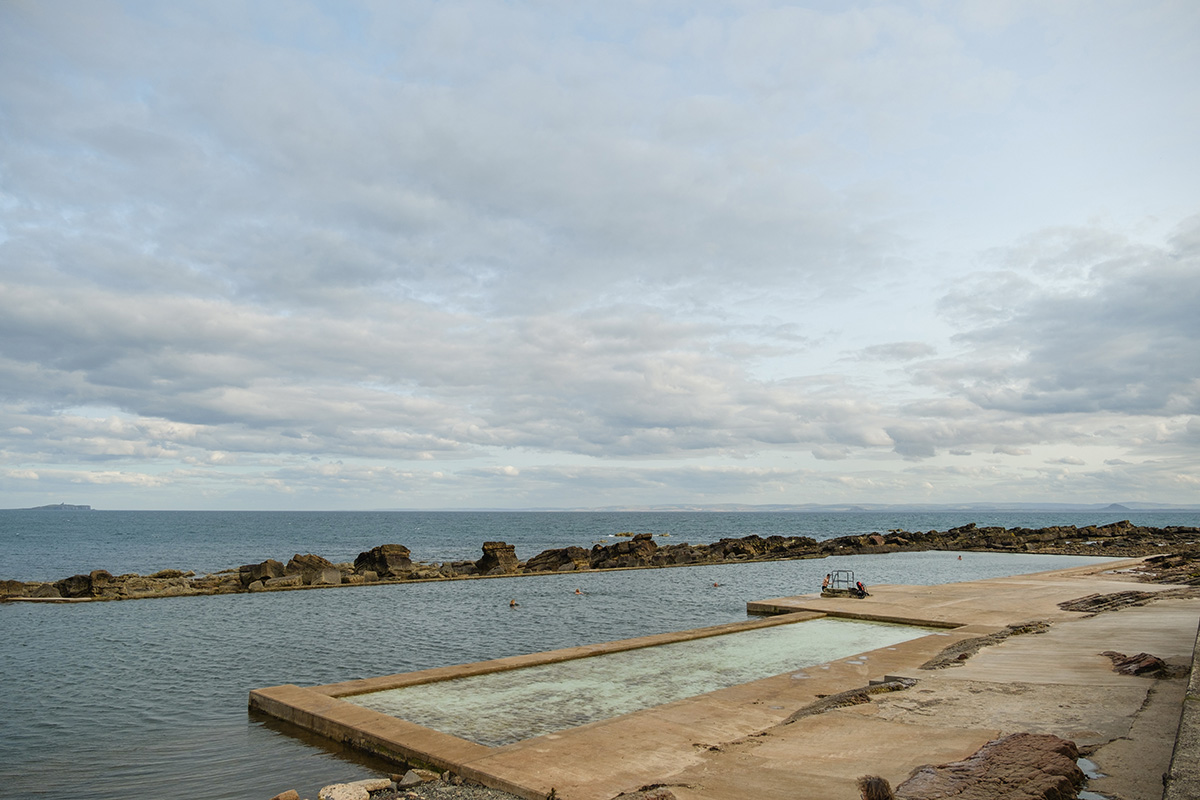
Cellardyke Tidal Pool was created out of an early-1930s tourism drive that had originally proposed a golf course was scaled back into something more modest, but far more loved: a tidal bathing pool built largely by volunteer labour under the direction of Robert Terras junior, using the natural “skellies” rock reef as its sea wall.
It opened formally on 17 June 1933, and by 1934 had been deepened, fitted with a high diving board and a swim chute, and had become the focal point of the town’s swimming galas, model boating contests.
A little further along, Pittenweem had its own Victorian-era tidal pool. Together with St. Monans Tidal Pool, these places formed a chain of communal bathing spots stretching the length of this stretch of coast — each one filled twice daily by the tide, each one a proper social occasion rather than a quiet dip.
When the neighbour of St. Andrews Seaside Sauna, East Sands Leisure Centre opened in 1988, The Step Rock finally, closed for good, its site eventually becoming home to St Andrews Aquarium.
For a generation, these pools sat quietly abandoned. Beautiful, slightly eerie reminders of a more communal era, visited mostly by dog walkers and the occasional curious outdoor swimmer.
What has brought these pools back to life is a movement that will feel very familiar to anyone who has ever booked a sauna session with us: the modern rediscovery of cold water as something to be sought out, not merely endured. The rediscovery of outdoor swimming over the past decade, accelerated by the pandemic’s renewed appetite for outdoor wellbeing, not only inspired me to open, what is now Scotland’s longest established owner-operated outdoor sauna, The Original Elie Seaside Sauna, but, has turned Fife’s forgotten tidal pools from curiosities back into destinations.
Pittenweem led the way. The local West Braes Project secured around £270,000 in funding to clear and restore the old sea pool, with volunteers removing decades of broken glass and rusted metal by hand.
The pool officially became swimmable again in February 2021 and reopened properly that August, and it has been busy with swimmers ever since. Cellardyke Tidal Pool has followed a similar path, with the same wellbeing wave that brought Pittenweem back giving fresh momentum to its own restoration after decades of decline.
Crucially, the way people are using these pools has changed. They have gone back to being places for multi-generational families to spend long summer holidays, however they also attract groups of locals, of a range of ages, mainly women, but all genders, who make use of the pools as a places to socialise.
Not just as part of a local, or visiting swim club, but also, in saunas, associated with each swim spot.
As well as Cellardyke Tidal, Scottish Seaside Saunas has at the point of writing this, received permission to site a sauna at Pittenweem Tidal Pool, that we hope to have on-site, by Summer of ‘27.
It is a very similar instinct which drove volunteers to hand-build these tidal pools out of a rocky reefs in early part of the C20th that drives the desire for locals and visitors, alike, to gather and brave the cold together and, to feel warmly, gratefully, alive afterwards, in one of Fife’s coastal saunas today.
St. Andrews and the East Neuk have a long tradition of outdoor swimming and my own, personal, family history mirrors this. We never referred to what we did as “wild swimming”, or even “outdoor swimming”. It was just swimming.
Swimming outdoors has always been my preferred place to swim, I chose where I went to university, to be close to the sea, I swam in The Long Pool, on Jesus Green, when I lived in Cambridge, in the outdoor pool, at The Oasis, all year round, when I lived in London and in very many outdoor and ocean pools, when I lived in Australia. Barely a week went by without, at least, one swim.
The sea, sea swimming and sauna, are part of me. It is not possible to separate them, from my identity. In selling you seats in my saunas, I am sharing with you what is normal for me, what is part of my family’s history and heritage, that we have done for generations.
So, next time you step out of one of our saunas and feel the pull of the sea, know that you are taking part in a tradition nearly a century old — and that the cold water waiting for you has been doing this far longer than we have.