I came back from the International Sauna Congress with a notebook full of mind-blowing concepts, from floating smoke saunas and mussel-growing platforms, to research on saunas and public health policy.
The theme I keep returning to is simpler. Over the 3 days of The Congress, in very different presentations, speakers kept describing the same thing from different angles: what turns sitting in a sauna, as a group of individuals, into a shared ritual and what are the benefits that this delivers.
Here is what stayed with me, and what it means for how we run things at Scottish Seaside Sauna.
A good ritual has a shape
The International Sauna Congress 2026 (ISC) was opened by Martijn Vanhoorelbeke, Founder of Aromen Essential Oils.
Martijn, a coffee connoisseur, who has made mapping tastes and flavours his life’s work, has analysed the factors that create an impactful Aufguss session.
To me, Martijn approaches Aufguss, like a composer approaches an orchestra.
To Martijn a sauna session as something composed, rather than, chaotic, spontaneous, or left to chance.
Heat, scent, rhythm and story all have to work together.
As Lasse Eriksen, President of Aufguss WM, Chair of Norge Badstulaug, Board Member of The International Sauna Association and Development Manager of Farris Bad, Larvik, near Oslo, put it, “If you put all the elements together, people just dream away.”
Scottish Seaside Saunas has hosted 3 Aufguss training sessions, delivered by Deborah Carr, of Anada, over the past 2 years, and has the fourth foundation course and first advanced accredited Aufguss course, in Scotland, scheduled for November 2026.
Our founder, Judith Dunlop, was the first credited Aufguss Sauna Master, in Scotland and we have 6 certified Aufguss Sauna Masters, on our team.
What having this knowledge means, to us, at Scottish Seaside Saunas, is not just the ability to create and deliver Aufguss rituals, inside a sauna, but to understand how the various elements that create a good sauna experience interact and can be manipulated and controlled to create, what Rachael McGrath described in the presentation that she made, later in The Congress, a specific experience in those who are in the sauna together.
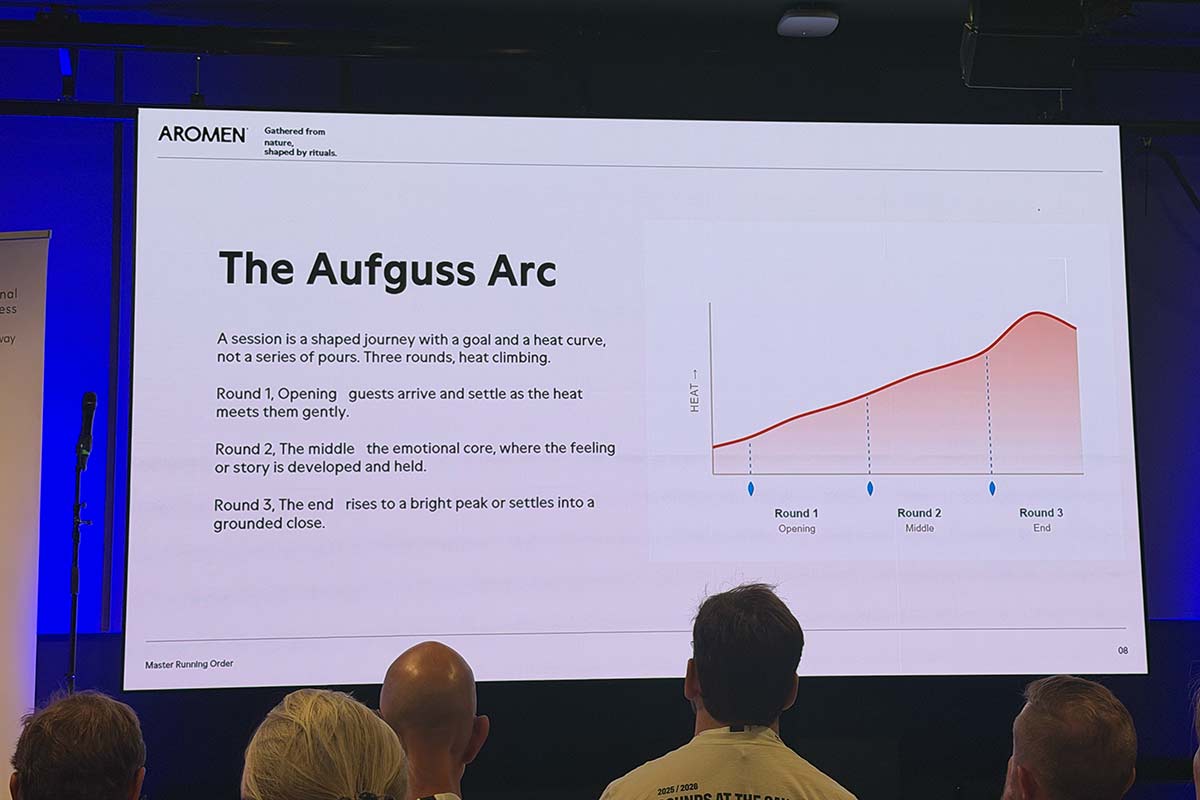
What Martijn explained, in his opening presentation, was that all these elements, when combined with knowledge, care and professionalism, can create a truly impactful sauna experience:
- The heat curve. A good session manages how the heat builds and how it falls, rather than just holding a temperature.
- A clear structure. The opening sets the scene. The middle is the emotional core. The end shapes how people leave the sauna, and that is the part some sauna practitioners often leave to chance.
- Scent as a layered experience. Oils have top, heart and base notes, and heat changes when each one is released, in the heat and steam of the sauna. Talking guests through what they are smelling, and letting them feel the heat, oil and aroma together, is part of the craft.
- Reading the room. The best hosts adapt to the people in front of them. The structure is a framework, and the connection with guests is what makes it work.
Martijn referenced his early experience as a carer, working with children with special needs, as helping him develop his concept.
He talked of a Snoezelen, a multisensory space designed for children with disabilities. This room is built by composing sensory elements into a safe place. A sauna ritual creates a similar ‘safe’ space.
A shared ritual builds belonging
Rachael McGrath’s presentation, later in the Congress, gave that idea a research foundation.
Rachael, please combination of of care co-authored a study with Dr Martha Newson and colleagues, published in Social Science & Medicine in 2026, exploring how social connection and ritual relate to wellbeing in UK sauna culture.
Across three studies involving 1,907 participants, drawn from the UK Aufguss Championships and Community Sauna Baths’ London sites, stronger identification with a sauna community was associated with better self-reported physical and emotional wellbeing.
What Rachael made clear was that, in one of the studies, two factors were linked to that stronger sense of sauna identity: perceiving sauna use as a ritual, rather than simply as time in a hot room, and experiencing emotional synchrony, the sense of feeling the same thing, at the same time, as the people sharing the bench with you.
That is a precise, researched way of describing something I see on the shores of Fife, where we operate our saunas, every week. The heat, the cold water, the quiet between pours: when a group goes through a ritual together, something shifts from an individual experience to a shared one.
The research suggests that the shared, ritualised element is not a nice extra, it is core to why sauna makes people feel better.
For us, as operators, that reframes the job. We are not just managing a temperature. We are hosting an experience people can share.
Rachael’s work preceded the sauna prescribing panel too, where the line that stayed with me was, “Health care is not just produced in hospitals. It is produced in nature. It is produced in community.”
It starts with leaving something at the door
One of the most impressive talks, was by Eda Veeroja’s on Estonian smoke sauna culture, which she is responsible for securing UNESCO-inscribed status.
Eda’s line has stayed with me: “Sauna day is when your soul says sauna.” Don’t just listen to your body, she said, listen to your soul.
Her advice is simple. Leave your ego and your thoughts at the sauna door. Take your roles off with your clothes and just be a human soul.
To paraphrase Eda, ‘Breathe in towards your spine, breathe out into your body, close your eyes and look inside. Talk to the fire and the water, not to the ego’.
Other speakers echoed this. Nina Magatova spoke of bringing spirit into the sauna through communication, time and interaction.
Anssi Lassila said happiness is based on contrast, which is something anyone who has gone from a hot bench into cold sea water already knows.
The research side backs up the feeling. Panelists described how sauna centres you in your body in the present moment, away from ruminating on the past, or worrying about the future. They also noted that passive socialising, simply being near other people, is soothing in itself.
It needs a place to land
Anna Talasniemi’s session on inclusion made a point I have thought of a lot, since visiting my first smoke sauna, when I went to Jyväskylä, in Central Finland, for The World Sauna Forum, in 2024 and reading Lassi Likkanen’s The Secrets of Finnish Sauna Design, the same year: people need somewhere to reflect after a ritual, so that it can sink in and they can make sense of what they just experienced.
‘If you give people a sense of belonging, they come back’.
The values behind the principles that she presented were privacy, safety, respect and no judgment.
A ritual only works if people feel safe enough to take part in it - and that includes the person delivering it!
Nina Magatova spoke of the safety of women practitioners in the sauna environment, but when she stated that, ‘if it’s not a safe place, it’s not a wellness space’, I thought more broadly about everyone in and around the sauna, as an environment.
We, in the sauna movement have to check ourselves, to make sure that we are broadly inclusive and not just doing good, but in the process, not doing harm.
It is held up by culture
Several speakers returned to how a sauna sustains itself. Knut’s version was “Judgment will kill it. Culture will keep it alive.” That applies to guests, and it applies to staff too.
As Nina pointed out, people working in a sauna should be able to do so without fear, and without having to manage someone else’s lack of restraint.
When someone crosses a line without worrying about the consequences, it is usually because there are no consequences.
Equality in the rota, the workplace and company policies is part of keeping the fire alive.
Such statements hold operators, such as ourselves to account. We have a duty of care to our employees. We must take care of our employees and make sure that they have the opportunity to develop and thrive.
The place matters too
The architecture sessions were a reminder that setting is part of ritual and the sustainability panel stressed materials that improve with age, wood that breathes, and keeping things simple and intuitive.
Maintenance came up too: little and often, oil the wood monthly, and do not scrub it. Good preparation and solid care of the sauna space, is part of the ritual.
What I am taking back to Scotland
• Shaping our Aufguss sessions with a deliberate opening, middle and end, and thinking about oils in terms of top, heart and base notes.
• Giving guests time and space to land after a session, not just to leave.
• Reviewing how welcoming we are, from clear etiquette and who we show in our marketing.
• Starting to document, with proper care, how our guests feel before and after a session.
• Keeping the sea, the fire and the community at the centre of everything we do.
A good sauna ritual is about putting things down, whether that is your role, your thoughts, or the day that you have just had, behind you, and being fully present in the heat, the cold and the company. I am looking forward to bringing more of that to the Fife shore.